As all rock and roll aficionados have probably heard, Lou Reed died yesterday following complications of the liver transplant he underwent in May. I am not a massive fan of Reed's solo work or his Velvet Underground material, but I appreciate his influence over future generations of folk and rock musicians looking to ignore genre categorizations and blur the lines between rock and jazz. Lou Reed was in many ways like a latter day Picasso. He was gifted with the ability to craft complex melodies and lyrics, but he disregarded popular music masquerading as realism in favor of abstract chord structures and sparse lyrics that were more like brush strokes than completed paintings. Reed once said, "One chord is fine. Two chords is pushing it. Three chords and you're into jazz."
image: timeentertainment.files.wordpress.com
Reed played and wrote without fearing complete commercial failure. His respective debuts with the Velvet Underground and as a solo artist failed to sell, but later gained massive cult recognition. Mentor Andy Warhol persuaded Reed and company to record with sultry-voiced German actress and cultural icon Nico for the Velvet Underground's debut album, but because she was never truly accepted as a member of the band, the album was entitled The Velvet Underground and Nico (1967). The original front cover even featured a peel-off banana sticker. The album was a melancholy and haunting dive into New York's alternative subculture of the late '60s.
image: collectorsfrenzy.com
Three albums later, the band had grown much more radio-friendly with 1970's Loaded, which contained both "Sweet Jane" and "Rock and Roll." Sweet Jane has one of the most endearing chord progressions in rock and roll (technically, the song includes FOUR chords) and has been covered more times than anyone can keep track of. The lyrics are resoundingly life-affirming in the way they paint the human condition in vivid dichotomies. For example, even though "life is just to die," "everyone who ever had a heart/they wouldn't turn around and break it/and anyone who ever played a part/oh wouldn't turn around and hate it." Here are some of my favorite covers (although Reed's acerbic delivery reigns supreme):
Staying true to his pioneering nature, Reed quit the band a few months before the release of Loaded to pursue solo work. His self titled solo debut flopped, so he turned to glam king David Bowie to produce his second, Transformer. The album broke the U.S. top 30 on the strength of "Walk on the Wild Side," and "Perfect Day" (which was actually about a less than perfect day).
He went on to achieve his dream of writing "the great American novel in the form of a record album," a few times, reflecting the fleeting reality of his lifestyle in New York. Reed was definitely a quotable man and a true artist at heart. "How can anybody learn anything from an artwork when the piece of art only reflects the vanity of the artist and not reality?" wondered Reed. Lou Reed was successful in capturing his reality, but only because he taught himself how to refuse to compromise at the most appropriate times.
There would be no Clash and no Sex Pistols if it weren't for the highly influential punk rock band The Saints. The group, led by singer-songwriter Chris Bailey, could be viewed as Australia's answer to the Ramones. In fact, The Saints released the second ever "punk rock" single in 1976 with (I'm) Stranded. Their sound eventually shifted to include more mainstream rock flavors, and by the time 1986 rolled around, their sound was barely recognizable. All Fools Day was released in 1986, and the record includes "Just Like Fire Would," the single that finally helped propel the group into the U.S. market.
image: www.recordsale.de
The opening guitar riff is an Australian
national treasure, and the song sounds triumphant, but the lyrics paint a
lonely portrait of an isolated man. He sits in his hotel room, "eyes
cast like steel," and "stays only to defy." He speaks of
the cold world outside before saying, "and just like fire would/I burn
up." The image is doubly powerful because "would" also
projects an image of fire "wood" burning. I'm not sure whether the proclamation is meant as an internal rallying cry (the warmth of the fire)
or a death sentence (burning up into nothing). I'm leaning towards the
rallying cry. Now, I'm not too religious, but I did take the "Bible
as a Story" class for my theology credit. Jeremiah 23:29 reads:
"'Does not my word burn like fire?' says the Lord, 'Is it not like a
mighty hammer that smashes rock to pieces?'"
The song could be telling of a man who is grappling with some sort of moral
or religious sin, and he must decide whether to attempt to move forward or do nothing and wait for the storm to come or pass.
Meanwhile, time is passing too quickly, and life's a struggle:
Five hundred miles I have gone today
Tomorrow it's five hundred more
Outside my window the world passes by
It's stranger than a dream
The final stanza seems to question the existence of karma or even an afterlife, mired in the insignificance of each day. Is day to day living worth the effort when death looms like "ice on the door?"
I go to work and I earn my pay load
And the sweat, it falls to the ground
I see you now, but we may never meet again, child
The ice is hanging on the door
But I can't leave you on that note. If the will to thrive is strong enough, the tables can be turned and death becomes insignificant.
I finished Linda Ronstadt's memoir Simple Dreams in three days last week, and I was inspired to start listening to her albums again. I know, I know, this is my second or third post about Linda Ronstadt, but she's in my top five artists of all time, so I can't help it! I have this CD box set of five of her Asylum albums. Unfortunately, Heart Like a Wheel was not included because it was released on Capitol Records. That situation was actually kind of interesting (prepare for a brief tangent here).
In order to get out of the rest of her contract with Capitol in order to sign with Asylum, Ronstadt's management worked out a deal that allowed her to immediately record one album with Asylum if the next album went to Capitol. After that, she could continue to record for Asylum. The arrangement was guaranteed to benefit Ronstadt's publicity because Asylum would try to outdo Capitol with its first Ronstadt recording, and Capitol would do the same with the following release. Each company would throw all of its corporate muscle into advertisement campaigns for the albums.
The first album on Asylum was 1973's Don't Cry Now, which was Ronstadt's first Gold album (500,000 copies sold) and a bonafide improvement over the previous Capitol release. The next album, reverting to Capitol, was 1974's Heart Like a Wheel. Heart went Double Platinum (selling over 2 million units) and hit number one on the U.S. pop and country charts, establishing Ronstadt as a landmark artist in the U.S. The next album on Asylum, 1975's Prisoner in Disguise was a decent followup and reached number 4 on the pop chart and number 2 for country.
(this is the box set- image: allmusic.com)
The box set is kind of random, beginning with Prisoner and including 1976's Hasten Down the Wind, 1977's Triple Platinum Simple Dreams, 1978's Living in the U.S.A., and 1979's Mad Love. Living also went to U.S. number 1 and sold over 2 million copies, and that is the album I will focus on for the rest of this post. I'm sorry I keep making these posts ridiculously long, but there's really no other way.
image: vnbits.org
Upon first listen, this album failed to impress me, especially after listening to the other aforementioned albums. In contrast to the flashy, uptempo tracks on those albums, Living is collection diverse songs spanning the century from a 1930s
standard ("When I Grow too Old to Dream") to a cutting edge Elvis Costello cover. It is an exceptional example of
how to meld styles and time periods to produce
a cohesive album with an overarching sound and theme. In retrospect, it's a miraculously prescient
transition album between her clear cut rock and country sounds of the '70s and new wave balladry of the '80s. The record includes new Ronstadt
collaborators including saxophonist David Sanborn. Overall, the atmosphere is a
little cool and detached, but it reminds me of someone looking in the mirror and pretending the person they are observing is someone else--a detached reflection on the trials and triumphs of a young life. And the album cover is kind of cheesy, but it's rumored that the popularity of roller skating actually increased across the U.S. as a result.
I'm not a fan of the Chuck Berry-penned "Back in the USA", but that's probably because I'm not a fan of Berry in general. The old time rock n' roll arrangement on the album felt very dated. The second song, "When I Grow too Old to Dream," is a bit of a bore. But the placement was strategic because the next song, "Just One Look", is a powerful midtempo rocker featuring some of Ronstadt's trademark falsetto improvisation near the end. This is where the album really gains momentum and refuses to slow down until the final track.
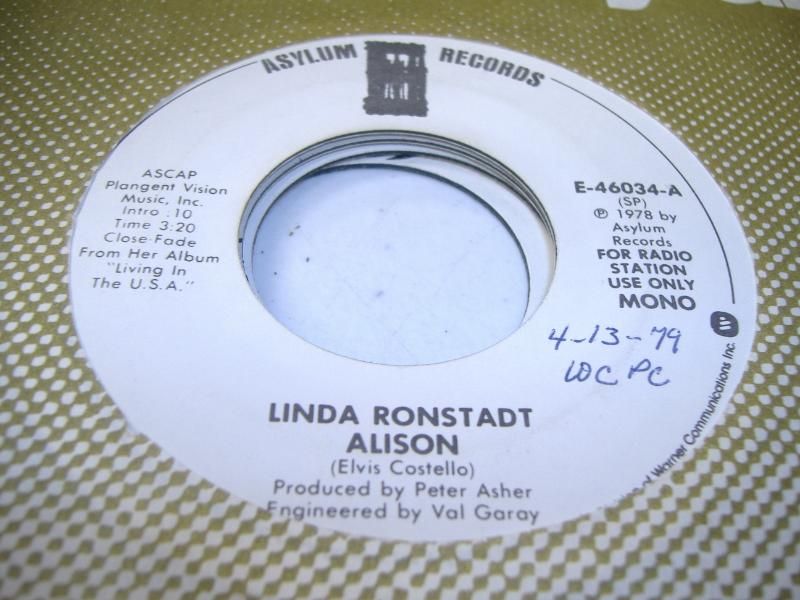
"Alison" was written by Elvis Costello and is one of my favorites on the album. Because the song addresses a woman, certain media outlets had a field day with the possibility that Ronstadt was gay or bisexual. However, she explained that she was singing the song about a friend named Alison who was going through a rough time ("Alison/I know this world is killing you"). Costello publicly expressed dissatisfaction with Ronstadt's interpretation, but he allowed her to use three of his songs on his next album because he "liked the money" her sales generated for him.
image: musicstack.com
In my opinion, the best and most controversial song on the album is former Ronstadt fling J.D. Souther's "White Rhythm and Blues." Souther songs appeared on nearly every Linda Ronstadt release, as did Karla Bonoff's compositions. He also wrote songs for the Eagles and was apparently obsessed with black roses. The core of the song is the intentionally vague lyric "all I need is black roses/white rhythm and blues/somebody who cares when you lose." I often switch the words "black" and "white" by mistake and think of the wealth of racial and cultural connotations implied by either order.
image: rateyourmusic.com
Black roses are associated with positive and negative symbology including death, tragic love, and rebirth. Historically, "white rhythm and blues" is also known as "blue-eyed soul," a genre exemplified by Dusty Springfield and Jerry Lee Lewis. Basically, top notch white singers and groups covered soul songs decently for the first time. A parallel can be drawn to early rock and roll groups including The Beatles, The Who, and The Rolling Stones, as all were heavily influenced by African American artists such as Little Richard and Muddy Waters. The true meaning remains a mystery, which may have been what Souther intended. I interpreted it as Souther's reflection on the blue-eyed soul genre and his attempt at writing a song inspired by that period in popular music.
Another song that dabbles in the abstract is "Mohammed's Radio", a Warren Zevon song I dedicated a previous post to. The cover lacks the irony of Zevon's original delivery. Zevon's singing is lighthearted and spontaneous in a way that offsets the potentially serious lyrics about the radio as salvation, whereas Ronstadt's technically perfect delivery lends itself to a more literal interpretation of the lyrics.
End it, end it!! Okay, this is the final paragraph. Ronstadt was often criticized (by Costello and many music critics) for singing that was too "white," too "technical." These critics say that her "perfect" voice lacks soul because it lacks an idiosyncratic identifier (such as Bob Dylan's nasally tone or Bonnie Raitt's bluesy phrasing) . But according to critic John Rockwell, "words lack music's emotional power but can be far more focused; the combination of words and music, then, can function as a dialectically potent artistic marriage." I like to think of Ronstadt's style as photographic. She was able to accurately deliver lyrics in a way that magnified their intended meaning. In other words, her mastery of auditory phonetics allowed her to bring the work of great songwriters to new audiences over the course of her successful career.
For my school's paper, The Saint, I often contribute to the "artist spotlight" section, a great addition to the culture page that the section's editor implemented about a year ago. The section has introduced readers to many talented artist they are unfamiliar with, and I have found some new favorites by reading articles others have written for the section. For the upcoming issue, I am working on a spotlight for Diane Birch, an artist I discovered last year via Pandora. I was listening to a station based on the music of Carole King, with Joss Stone and Adele added in for some variety, and Birch's song "Fools" (which I believe I have already included in a previous post) just absolutely blew my mind. I bought the album it's from, Bible Belt, and it passed the acid test, playing on repeat in my car for weeks. After a three year wait, Birch's sophomore album will be released on October 15th and is currently streaming here. The following is an excerpt from the upcoming article. I sure hope you'll all give the album a listen, because it really has something for everybody.
Artist Spotlight: Diane Birch
“My goal is to make people dance and
cry,” proclaimed Diane Birch in a recent interview with Philthy magazine. The
singer-songwriter’s latest effort is Speak
a Little Louder, released on October 15, is certainly capable of realizing
such an audacious desire. The album
follows a nearly three year break following 2010’s Bible Belt, a piano driven collection of pop songs inspired by
classical music and Birch’s globetrotting childhood as the daughter of a
missionary preacher.
image: amazon.com
Birch learned to play piano by ear
at the age of seven as a student of the world renowned Suzuki method, and she’s
been developing unique vocal trademarks since then. Showcasing a voice that slings power and pain
across stylistic and temporal boundaries, Birch’s songs encompass all of the
breezy joy and yearning of historical pop hits along with lyrical heft and
musicality to rival proven greats like Carole King and Adele. Birch's music is
immediate and heartfelt, avoiding the chronic detachment that plagues
many trendy songwriters and indie bands.
Originally intending to compose
film scores, Birch, a Michigan native, was discovered in 2006 at the age of 23 by the
one and only Prince at a piano bar in the Beverly Hills Hotel. An impromptu jam session with the cultural icon
opened the door for Birch to pursue singing as a full time career.
Bible
Belt, regardless of overt religious undertones in the title, was intended as an
expression of freedom from the restraints of externally imposed
spirituality. Birch’s debut introduced
the world to a singer with genre-bending capabilities and the potential to
expand into jazz, soul, dance, and rock. Arrangements on that album are sparse and
cohesive, featuring Birch pounding out retro tinged songs on an antique
Wurlitzer piano. “Rewind” was exquisitely reworked by English rapper Devlin, becoming a top ten hit in the United
Kingdom.
image: flashwounds.com
Speak
a Little Louder solidifies the artist’s nature as a fearless experimenter
who is constantly evolving. It’s hard to
imagine skipping a single track because each song is brought to complete
fruition with a wider palette of instruments to paint with. Additional electronics are implemented to
crystallize Birch’s visions. The
standout track, “Frozen Over,” includes percussion reminiscent of the late ‘80s
Stevie Nicks song “I Can’t Wait,” and indie-tinged rocker “Lighthouse” sounds like
a supercharged Florence + the Machine ballad.
Prince’s influence can be heard on “Love and War,” an irresistibly hook-driven
torch song. The album is surely one of
2013’s best.
Right now, I am pretty exhausted from the work week, so I'll try to keep this brief. Tonight features an overview of four influential soft rock groups of the 1970s that, upon first glance (and listen), seem nearly impossible to keep straight.
1.) AMERICA
image: rocknewsdesk.com
Members: (left to right) Dan Peek, Gerry Beckley, Dewey Bunnell
Countries of origin: England and the United States
Years active: 1970-present
Claims to fame: Two #1 hits and seven top 10 singles in the U.S.; received a star on the Hollywood Walk of Fame in 2012
How to remember them: All three founding members had American fathers and British mothers because their fathers were military men stationed at a London Airforce base. All three eventually moved to the United States, and they chose the name "America" because they did not want to be perceived as Brits mimicking the sound of American rock.
Members: (clockwise from top) Mike Botts, James Griffin, Rob Royer, David Gates, Larry Knechtel (not pictured)
Country of origin: United States
Years active: 1969-1977, brief reunion in 1996
Claims to fame: One #1 hit and five top 10 singles in the U.S.; Larry Knechtel was a member of the group of Los Angeles studio musicians known as "the wrecking crew," and he played on records by many important artists including Elvis, The Mamas and the Papas, The Doors, The Beach Boys, and Simon & Garfunkel.
How to remember them: The name "Bread," slang for "money," was chosen ironically to draw attention to the dishonesty of bands who claimed to be indifferent to money.
Members: (left to right) James Seals and Darrell "Dash" Crofts
Country of origin: United States
Years active: 1969-1980, 1991-92, 1994
Claims to fame: Three top 10 singles in the U.S.
How to remember them: Just think of them as the devil's advocates--the group had three top ten hits, all of which peaked at #6. Also, both members are from Texas and their daughters, Juliet Seals and Amelia Crofts, currently play together in a band called The Humming Birds, which may have been named for the Seals & Crofts song "Hummingbird".
4.) Crosby, Stills, & Nash (& Young, when he felt like it...)
image: kenmeyerjr.deviantart.com
Members: (left to right) Graham Nash, Stephen Stills, David Crosby
Countries of origin: England (Nash), United States (Stills, Crosby), and Canada (Young)
Years active: 1968-1970, 1973-74, 1977-present
Claims to fame: All four members have been inducted into the Rock and Roll Hall of Fame twice; two top 10 singles in the U.S.; far more renowned as solo artists than band members (well, except maybe Crosby).
How to remember them: The members all came from other successful bands: Nash emerged from British rock and roll group The Hollies, Stills from Buffalo Springfield, and Crosby from The Byrds. Young also played with Stills as a member of Buffalo Springfield. The name of the group consisted solely of names in order for each member to retain his respective individuality and musical identity.
In summary, these bands are not particularly radical or revolutionary,but they exemplify craft in action. Harmonies are exquisite and instrumentation is organic. These bands helped rescue popular music from the vortex of acid rock, reminding us that it's okay to partake in some illegal substances, but only enough to feel that summer breeze "blowin' through the jasmine" in your mind.
Since singlehandedly reinvigorating
indie pop with the release of the single “Forever” over a year ago, Haim has
kept fans waiting. The band of sisters
chose to release a long string of singles before announcing a debut album,
which will finally drop on September 30 (but I was lucky enough to find it online after it leaked--but of course, I am still buying the album because I care too much about music to do otherwise).
From the first pulse to the final fade out, Days Are Gone is a tightly woven masterpiece that delivers on every
promise and may even a have the power to act as a unifying force within the
tangled mess that is contemporary music.
image: weworemasks.com
Two of the band’s most popular
singles, “Falling” and “Forever,” draw listeners in as strong opening tracks. The gloriously lo-fi, vamping guitar leading
into the final chorus in “Forever” ensures that the song will live on as an all
time classic. The next track, “TheWire,” begins with a simple guitar riff that lends the song a breezy, Southern
California vibe anchored by tasteful synthesizer and Este Haim’s signature bass
line. The Haims trade off vocals during
verses before coming together for golden three part harmonies on each chorus.
“If I Could Change Your Mind”, the first brand new song on the record, masterfully utilizes
tempo changes to amp up the impact of each subsequent chorus. Danielle Haim’s soulful vocal and staccato
guitar border on stream-of-consciousness and preach from experience, admitting
“Every time I think about it/memories take me back to all the wildest
times.” The song speaks to the intense
pull of memories, no matter how much an individual may try to avoid them.
The
title track, placed just past midway through the album, stands out for a couple
reasons: it was co-written by R&B
extraordinaire Jessie Ware and indie songwriter Kid Harpoon, and it’s the only
song that does not feature Danielle Haim on lead vocals. Instead, Alana Haim takes over, adding edgier
vocals to a backbeat heavily influenced by electronic dance music.
It’s apparent that “Days are Gone”
serves as a jumping off point for the more sinister nature of the rest of the
record. The daring “My Song 5”continues
with EDM grooves, but “Go Slow” is the true masterpiece of the album. Ethereal backing vocals and a hypnotic drum
loop converge to create feelings of claustrophobia while an accusatory chorus
chants, “You took away all my young life/ and I hate what I’ve become.” Although all of the songs, and especially those
on the second half of the album, rely heavily on technological enhancements, raw
guitar solos and soulful vocals assure listeners that indeed, human beings are
the force behind such lush electronics.
In Israeli, “Haim” means “alive,” a
perfect adjective to describe Days Are
Gone. Many critics have attempted to
define Haim by comparing the group to a bizarre conglomerate of bands that have
passed their prime, including Fleetwood Mac, The Strokes, and TLC. But Haim, unafraid to dabble in the immediacy
of pop and undeterred by experimentation, has demanded to be defined on its own
terms.
So as the first of my highly anticipated albums of autumn, Days Are Gone has definitely exceeded expectations.
The Eagles are a truly great American band--the same cannot be said about Fleetwood Mac, The Rolling Stones, or other partially or completely English bands that gained a U.S. following in the '70s. The Eagles exemplified the "California sound," that melodically soft-rocking hybrid that crashed over the States like a Pacific tsunami, although none of the band's original members are native Californians. They learned the art of songwriting by eavesdropping on Jackson Browne's morning practice sessions through the floorboards of an Echo Park apartment. An alarming number of their early hits were written or co-written by outside songwriters . How were the Eagles, a band that should have been mediocre on paper, able gain authenticity on the way to selling the most copies of any single album released in the twentieth century?
Well, to begin, each member of the original lineup hailed from a different region of the country and brought different regional influences to the music.
The Michigander in the group, co-lead vocalist and lead guitarist Glenn Frey from Deeeetroit city, was hot stuff, and he knew it. He brought all the swagger the group would need to snatch a major label deal away from all of the other needy bands forming in L.A. in the early '70s. Musically, Frey was influenced by Motown and polished his guitar skills alongside Bob Seger (Frey contributed guitar and backing vocals to Seger's 1969 album Ramblin' Gamblin' Man). Frey gave the Eagles an edgier rock sound that set them apart from more mellow guy groups like America, Bread, and Crosby, Stills, and Nash. My favorite songs with Frey on lead vocals are "Already Gone" (written by Jack Tempchin and Robb Strandlund) and "Lyin' Eyes" (written by Frey and Henley).
Drummer (and Stevie Nicks hookup number one) Don Henley nearly shoved Frey out of the picture, thanks to his golden vocals, revered among the best in rock. A southerner at heart, Henley's upbringing in the small, agricultural town of Linden, Texas exposed him to the ragtime of Scott Joplin, Western swing, and classic country along with the popular music of The Beatles and Elvis. My top two songs with Henley on lead vocals are "Desperado" (written by Frey and Henley) and "Best of My Love" (written by Frey, Henley, and J.D. Souther). The brains of the group, Henley majored in English Literature at North Texas State University and adopted a quote from Emerson's Self-Reliance as his call to arms: "Beware what you set your heart upon. For it surely shall be yours."
Bernie Leadon, banjo enthusiast and former member of country rockers The Flying Burrito Brothers, was raised on Minnesota bluegrass. Leadon put the "country" in "Eagles" and contributed important harmony parts until leaving the band in 1975.
Randy Meisner, the high-harmony singing boy next door, was a founding member of Poco before joining the Eagles as a bassist. He was famously replaced by a dog on Poco's debut album cover, which can be observed in the linked video. Meisner co-wrote 9 Eagles songs including "Take it To the Limit," on which his unbelievable high note at the end (skip to 4:23) was the reason for his departure in 1977.
Together, the founding four met in Linda Ronstadt's backing band once they were all settled in L.A. Once they asked her opinion, Ronstadt encouraged them to form their own group. The Eagles were established in 1971. There were arguments and lineup changes along the way, but whenever the Eagles toured, they were a force of nature.
When the sessions for the 1974 Western-themed concept album On the Border required a slide guitarist, Bernie Leadon's friend Don "Fingers" Felder joined the group as a second lead guitarist. Felder traded guitar licks with Frey on "Already Gone".
Bernie Leadon left the band in late 1975 and was last recorded on 1975's One of These Nights. Citing differences in musical taste (Leadon much preferred country to the harder rock direction the Eagles were headed in) as well as a personal desire to find time to exercise and get healthy, Leadon still managed to go out with a bang after breaking a beer bottle over Glenn Frey's head following an argument on the night of his departure.
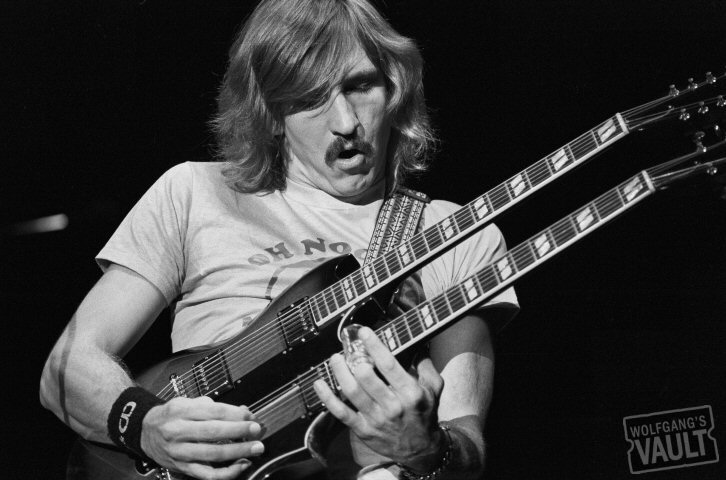
The same day of the announcement that Leadon had left the band, the band gained a firecracker in lead guitarist Joe Walsh (Stevie Nicks hookup number 2).
Walsh had already attained some mainstream success as lead guitarist and vocalist for The James Gang as well as with 1973 solo jam "Rocky Mountain Way". Walsh took Frey's edginess and kicked it up about fifty notches with an aggressive guitar tone and imaginative riffs and solos. Walsh influenced the band immediately, earning them a hit with the fast-paced "Life in the Fast Lane" from the 1976 album Hotel California. Constantly battling drug and alcohol abuse, it was a miracle Walsh could hold up for an entire show on some nights. Healthy competition between Walsh and Felder developed on tour as they took part in live guitar duels on the song "Hotel California.".
During the Hotel California tour, Randy Meisner was having health issues related to exhaustion, which he felt affected his ability to hit that high B at the end of "Take it to the Limit." The song was an undeniable crowd pleaser, and Frey attempted to pressure Meisner into performing it one last time for an encore (to literally "take it to the limit one more time," I guess you could say...), which pushed Meisner to his breaking point as far as dealing with The Eagles was concerned.
It would seem like finding another high harmony singer who played bass would prove difficult, but Poco was able to provide another. Enter Mr. Timothy B. Schmit, Meisner's successor in Poco (he wrote a hit for that group with "Keep on Tryin'").
Harmony extraordinaire Schmit has recorded with CSN, Firefall, Andrew Gold, and Steely Dan. So he was definitely up for the challenge when he was called upon by The Eagles in 1977. As another member who made an immediate impact on The Eagles, Schmit wrote and sang lead vocals on "I Can't Tell You Why" a song from 1979's The Long Run. The song reached number 8 on the Billboard Hot 100, and the Eagles entered the era of glossy rock. Timmy B. is a personal favorite. I'm not exactly sure why--maybe because his hair looks like mine, or because he's just kind of adorable. Plus, he must be an eternal optimist, because after surgery for throat and neck cancer in late 2012, he already has his singing voice back.
The Eagles broke up for the first time in 1980, which was inevitable given the amount of time these people spent together on a daily basis. The event occurred on a fateful night in Long Beach. The band was performing at a benefit for senator Alan Cranston, but Don Felder hated performing for free. Felder and Frey's relationship had been on the rocks since recording The Long Run, but when Cranston individually thanked each member of the band prior to the concert, Felder replied with a "you're welcome...I guess," which infuriated Glenn Frey. During the performance, Felder and Frey were giving each other death threats, which were captured on tape. Felder was then fired from the band.
"Somebody's gonna hurt someone/before the night is through/somebody's gonna come undone/there's nothing we can do." -Heartache Tonight
All of The Eagles except for Leadon and Meisner reunited in 1994 and have released two more albums of new material and toured on and off since then. Leadon made guest appearances on the most recent tour, but has not rejoined the band full time. After everything, there is still one thing no one can take away from this band:
Their Greatest Hits(1971-1975), an ambitious release for a band with only four albums worth of material at the time,will always be the best selling individual album of the Twentieth Century. And Timothy B. Schmit's hair will remain a constant.