Thursday, September 5, 2013

Five Albums I'm Looking Forward to this Fall, Part 1

1) Haim, Days Are Gone, Sept. 30

          I discovered Haim, a band of three sisters from Los Angeles, through Rolling Stone, which has proven itself time after time as an extremely reliable source for judging the quality of new bands, at least according to my taste (couldn't resist the link...I can't help thinking in lyrics sometimes...).  I have never heard anything remotely like the music this band makes.  In a nutshell, they are not trying to imitate anyone, which is very refreshing.   When I noticed that their single "Forever" was gaining attention on the indie pop scene, I decided to keep an eye out for their next single.  I never trust a band with only one popular single for a few reasons.  First, the single could represent the extent of their musical abilities.  So many young indie bands rush to labels and secure deals before they are entirely aware of their artistic vision.  Sadly, major labels attempt to pigeonhole bands into certain genres to ensure the music will have immediate listenership and radio airplay.  Once an image is established, changing that image is assumed to be bad for sales (unless, of course, it's Cher...see number two on the list).  In these cases, the songs will sound too similar and I'll lose interest in the band quickly.


               Each of Haim's subsequent singles has retained the urgent vocals, heavy emphasis on rhythm, and intriguing yet catchy hooks.  However, each release has a life of its own, making this band the ultimate pop/rock/rhythm and blues chameleon.   From seriously tearing up Fleetwood Mac's "Oh Well" to the Beach Boys-esque "Honey and I" to the anthemic "Send Me Down", Haim represents a more mature version of everything I enjoy about the few indie bands I can actually stand listening to for more than half a song: raw guitar riffs, intelligent lyrics that aren't narcissistic, three part harmonies, and an incredible bass player.  And this band has been winning over festival crowds for six years. Astoundingly, they are able to recreate the singles flawlessly on stage.  I actually prefer their live tracks over the studio material because each musical element is discernible, and their producer has an annoying habit of compressing those elements into something that leans more towards pulsating dance pop than rock.   Already having opened for Florence and the Machine, Ke$ha, and Mumford and Sons, all of which I consider inferior artists, Haim is poised to take the indie world by storm...and survive to tell the story decades from now.

Here's my ranking of officially released Haim singles:
Forever
Don't Save Me
The Wire
Send Me Down
Falling

And for more information about the band, here is an article I wrote for the college paper (August 22nd issue, page 3).

          I am actually supposed to be posting every week day, and I need to play a little catch up, so I will post each of the next four albums as a separate entry.  Later!

2) Cher, Closer to the Truth, Sept. 24
3) Diane Birch, Speak a Little Louder, Oct.15
4) Pearl Jam, Lightning Bolt, Oct. 15
5) Patty Griffin, Silver Bell, Nov. 8

Image: consequenceofsound.net

Sunday, September 1, 2013

Song Review: Warren Zevon, Mark Edmundson, and "Mohammed's Radio"

Critically acclaimed songwriter Warren Zevon only had one hit of his own:  1978's "Werewolves of London", which he considered to be a practical joke on the record company.  Although his albums have been produced by Jackson Browne, his songs have been recorded by Linda Ronstadt, and his music has been promoted by David Letterman, Zevon's writing is just off kilter enough to scare listeners away.  His songs evoke the cinematic scope of old Western novels doused in a heady cocktail of psychoanalytic theory.


As I was driving home from South Haven last night following a long day of magazine distribution with my ipod on shuffle, "Mohammed's Radio" captured my attention. For Zevon, the song is relatively tame and uncharacteristically straightforward.  The radio has a divine presence in the lives of listeners, who range from the working class to sheriffs and even "the village idiot."  Just as people often turn to religion for comfort and security, turning on the radio can have an effect just as powerful as an organized mass or a solitary prayer.  Interestingly, instead of using a Christian figure as a metaphor for radio, Zevon chose the Islamic prophet Mohammed.

Let's take a look at the people mentioned in the song. "Everybody" refers to the working class, who are "restless" while "trying to make ends meet."  In the first verse, these people are frustrated with having to spend all of their waking hours working, or perhaps even with the failure of religion to bring them peace.  They feel trapped, which angers them and stirs feelings of self pity, or "anger and resentment."  Later in the song, Zevon reveals that their lives are unfulfilled because of the persistent struggles for livelihood and self realization.  This phenomenon is described with typical Zevon callousness as a failure to pay for "gasoline and meat."

The next verse could easily be set in the local bar, where sheriffs wait in the parking lot and watch patrons enter and exit, breaking up any fights that may begin.  The "village idiot" may be a troublemaker or one of the working class, from the sheriff's point of view, or he could represent an entirely different demographic, content in his obliviousness.  Either way, "the sheriff's got his problems too," and all anyone in town can do to ease their pain is to listen to the radio...Mohammed's radio.

The narrator in the chorus is distracted from his problems by a voice on the radio.  The fact that this voice is referred to only as "somebody" implies both separation and closeness.  Somebody apart from the people in the song, but at the same time, somebody that may represent the fully realized versions of each person in the song.  Why else would the voice captivate them so completely?  The voice on the radio is motivating, enticing listeners to "stay up all night listening" as if worshiping the radio in the church of night where it is permissible to escape and to dream, a place where life makes sense.


But the listeners are warned to "be watchful for Mohammed's lamp," because dreaming too much will only make facing reality more difficult, and staying up all night listening is probably not advisable for people with jobs to keep.  This idea, that music's powers are limited and possibly even detrimental to listeners, reminds me of an essay by Mark Edmundson entitled "Can Music Save Your Life?".  In the essay, Edmundson credits Bob Dylan's "Like a Rolling Stone" with making him "feel like life was larger than I thought and making me feel like I wanted to find out what I was missing."  Well, what if the idea that you're missing something had never occurred to you before?  On one hand, you'd be stunned and possibly intimidated.  On the other, your potential as a human being just multiplied exponentially.


Alternately, Edmundson acknowledges that he used music to "tune out his moods," and asks a timeless question:  "Do we sometimes go to music to hide from our fears that the world makes no sense at all?"  The same question could be asked with "religion" in place of "music."  At the end of a night listening to the radio, to put it frankly, nothing has been accomplished and no questions have been answered.  The illusion of self-help, or even of a deeper connection with mankind, can be explained by what Edmundson recognizes as a fabrication of experience.  Music can only be a savior if it moves us to action, and if we take care to avoid living vicariously through music while constantly facing dissatisfaction with our own respective realities.

"The best thing hearing music can do for you is make you want to make your own," wrote Edmundson, and he is correct.  For me, music sparked an intense desire to create and a motivation to succeed and to never stop trying, a thirst that could not be quenched by listening to more music.  I wanted to be that "soulful voice" not literally, but fundamentally, through writing.  I still have the desire to inspire people in the way that I have been inspired so many times it seems impossible to repay the debt.

But maybe the song shouldn't be interpreted so seriously, seeing as the songwriter wrote it after he spotted a mentally handicapped man dressed as a Sheikh on Halloween, holding a radio.  And maybe we shouldn't take ourselves so seriously.  Anything in life has the power to inspire, as Zevon has proven, but only we have the power to create.

Images:
http://www.last.fm/music/Warren+Zevon/+images/157016
http://www.freewebs.com/oldradios/galleryno2.htm
http://chronicle.com/article/Can-Music-Save-Your-Life-/132040/

Thursday, August 29, 2013

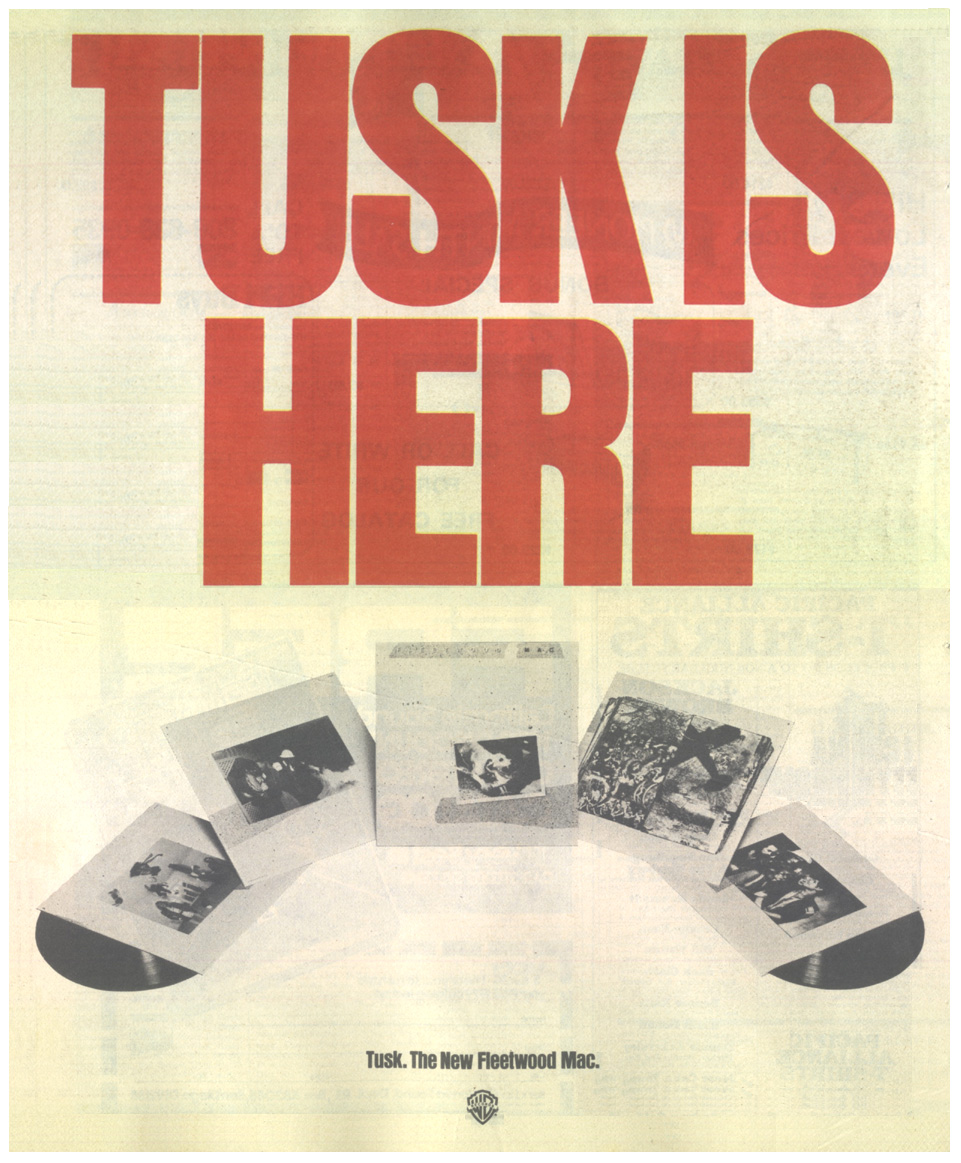
Album Review: Fleetwood Mac Get Tusked

If you were to ask someone to name a Fleetwood Mac album, the first (and probably the only) album to come to mind would be Rumours.  Although Rumours was an undeniable triumph, selling more than 19 million units to date and claiming multiple album of the year awards in 1977, Tusk is the band's masterpiece.  Released in 1979 under the influence of mounds of cocaine, alcohol, and that magical synergy that had always existed within the group, Tusk received mixed reviews.


Well, I'll just say that I doubt anyone has displayed that album cover (a studio engineer's dog) as wall art.  Fans and critics were expecting the band to follow the formula that had served them so well with Rumours.  However, during the making of Rumours, the band nearly fell apart at the seams.  This story has been rehashed in every single Fleetwood Mac interview since 1977, but for those who are unaware, bassist John McVie and keyboard player and vocalist Christine McVie divorced, Lindsey Buckingham and Stevie Nicks split up, and Stevie had an affair with drummer Mick Fleetwood.  Oh, and then prior to the recording of Tusk, Mr. Fleetwood cheated on Stevie with her best friend, Sara, an event which inspired the song "Sara."  After so many personal upheavals, it makes sense to me that the band wouldn't want to relive Rumours.  But the record company needed a follow up, so they drowned their sorrows and returned to the studio.

Lindsey Buckingham played a much larger role in the production of Tusk than in that of Rumours, even recording percussion parts on studio chairs when he had one of the world's greatest rhythm sections at his disposal.  British punk was beginning to rear its head in the states, and Buckingham was inspired by the harsh imperfections and dissonance of the music.  Following Christine McVie's characteristic opening track "Over and Over", Buckingham wasted no time in asserting his newly adopted artistic vision and pouring out his frustrations from the past few years with "The Ledge".  The Clash meets rockabilly?

The rest of Lindsey's tunes definitely echo the mood of "The Ledge," but although they seem simple, his leadership in the studio helped him and the band as a whole craft a much more raw and introspective album than Rumours.  This video, which is part of an amazing documentary on the making of Tusk (seriously, I could watch this documentary every day of my life), shows Lindsey and John working on a bass part for his song "Save Me a Place" as well as with Nicks for her song "Angel".  Regardless of personal differences and arguments, the band worked as a team in the studio.  Although some may criticize what appears to be Buckingham's power trip, he actually worked individually with each member in order to push them to produce the best music of their careers.

And yes, that famous "Tusk" riff was actually recorded by the University of Southern California marching band, an added touch of grandeur from a band known for choosing paint colors for hotel rooms and having them furnished with white grand pianos.  Mr. Fleetwood even wanted to take the entire marching band on tour before considering the price tag.  Recording on a yacht was obviously an option as well.  Although in my opinion, the band was peaking as live performers on the Tusk tour, they barely broke even on the tour due to excessive spending and mismanagement of money.  Mick Fleetwood was then fired as the group's financial manager, but of course retained his occupation as the band's drummer.


Buckingham was also the driving force behind the decision to make Tusk a double album.  Releasing a double album is always frowned upon by record companies because of the fear that the higher price tag will lower sales and discourage listeners.  The band actually blamed Lindsey's production and decision making after album sales did not live up to expectations, although a California radio station aired the album in full as a preview, practically inviting listeners to record the broadcast on cassette and avoid buying the album and all of the angst ridden artwork that came with it:


Another gripe many listeners have with the album is its perceived lack of continuity.  Even casual listeners will notice that the record sounds like a conglomerate of three different artists rather than three songwriters within the same band.  That may have been the goal, though.  Perhaps the songwriters had finally learned some respect for personal space.  With room to breathe and experiment, all three writers revealed more of themselves on Tusk than on any other Fleetwood Mac recording.  So I ask you to give the album a chance to displace Rumours as the most played album in your Fleetwood Mac discography.

Images:
http://en.wikipedia.org/wiki/Tusk_(album)
http://www.superseventies.com/fleetwoodmac4.html
http://www.fleetwoodmac-uk.com/art/index.php?album=Fleetwood+Mac+Bootleg+Artwork%2FAudio%2FAlbum+Outtakes%2FTusk%2FTusk+Take+Two

Wednesday, August 28, 2013

Song Review: Bruce Springsteen's "Thunder Road"

After my Beatles phase, which lasted from about fifth grade until eighth grade, I started listening to Bruce Springsteen's 1995 Greatest Hits album.  I usually only listened to the first song, "Born to Run," because I was a runner.  At that point, I didn't care to look into any deeper meanings the song may have held.  The second song on the album, "Thunder Road" bored me with its slow harmonica prelude, and I didn't even give it a full listen for months. I finally decided to give the song, and the rest of the album, a chance after my mom told me about a project she was assigned in a college art class.  She had to construct a display inspired by a song, and she chose "Thunder Road."


To this day, "Thunder Road" is my favorite Springsteen song and one of my favorite songs of all time.  The opening verse unfolds like a black and white film:  the reluctant creak of the harmonica symbolizes a screen door opening to a wooden porch; the piano represents the song playing on the radio.  The tension between the man in the car and the woman on the porch is established.  Will she jump in the car and leave with him, or will she remain and live a life that's already been planned for generations? This theme of escape, of weighing the costs and potential benefits of leaving a life behind, is paralleled in several other songs of note, including Tracy Chapman's "Fast Car."  The more important question the characters in the songs must ask is whether they have a choice.

The most poignant verse, in my opinion, is the second.  I interpret the verse as a flashback to the dark days of the couple's relationship, when they had separated for a while:

You can hide 'neath your covers
And study your pain
Make crosses from your lovers
Throw roses in the rain
Waste your summer praying in vain
For a savior to rise from these streets
Well now I'm no hero
That's understood
All the redemption I can offer, girl
Is beneath this dirty hood
With a chance to make it good somehow
Hey what else can we do now...


I think everyone must hold an ideal vision as to what their life could be and what the future could hold.  Sometimes the vision can be blinding, unattainable, or both, causing one to become discouraged and waste time chasing something that doesn't exist.  The girl is "praying in vain" for her vision to become a reality, for her "savior to rise."  However, the savior is a construct of her mind, so he cannot logically exist.  Left with the self-proclaimed next best thing, the man claiming himself as "no hero," she has to decide whether to keep waiting for a fictional savior or accept the journey ahead of her with this nobody, with no guarantees.  There may be no chance of a savior, but there is a concrete opportunity with this man, a "chance to make it good," and we never actually find out what she chooses.  

The rest of the song launches into a possible scenario of escape and freedom, but at the end, she is still standing on the porch.

And in the lonely cool before dawn
You hear their engines roaring on
But when you get to the porch they're gone on the wind
So Mary climb in
It's a town full of losers
And I'm pulling out of here to win.


The young man is trying to tell her that the footholds of reality can be much more satisfying than mourning an illusion, but nearly the entire song was a description of his fantasy of escape.  So at the end, they are back where they began: with each other, and with themselves.  

Image: http://blog.hemmings.com/index.php/tag/bruce-springsteen/

Tuesday, August 27, 2013

Linda Ronstadt and the Anatomy of a Cover Song

Because of the recent news of Linda Ronstadt's Parkinson's diagnosis, I had planned to review her 1975 album Prisoner in Disguise.  As a biology major, I am still a bit preoccupied with the potential link between Lyme disease, acquired via ticks, and Parkinson's disease, but that's beside the point (although as you will note in the linked article, all of the singer's problems began following an unspecified tick borne illness).  But now, to the music

Although she is the queen of covers and has seldom written songs, Linda Ronstadt's voice is peerless because when she sings, you believe her.  Covering a song well is not as simple as playing along and singing in key.  Above all, definitive cover songs must be convincing.  On the technical side of the spectrum, the music must suit the vocalist's range and unique abilities, but the singer must also be able to relate to the song's lyrics on a deeply personal level.  Even though someone else wrote the song, the singer must feel as if they have lived the story within the song.  Telling the truth requires far less effort than telling a lie, although both require courage.  Similarly,  just as good liars can get away with things, technically superior vocalists can sometimes "steal" a cover from their more emotionally honest peers.

And now I can see that I really want to take this post to discuss cover songs.

 When I was in high school, Ronstadt was scarce in my parents' collection, and I didn't have money to buy music, so my exposure was limited to "You're No Good" (and here is the first recorded version, also a cover), which compensated for the lack of quantity with quality.  I chose that particular video because the contributions of Ronstadt's band members are showcased.  They were some of L.A.'s finest session men:

1) Waddy Wachtel, whose professional resume includes studio work with Stevie Nicks, Jackson Browne, James Taylor, Keith Richards, Carly Simon, Carole King, Bob Dylan, and The Rolling Stones, to name a few.

2) Andrew Gold, a singer-songwriter who has worked with three of the four Beatles as well as Freddy Mercury, Cher, and even Jesse McCartney.
3) Dan Dugmore, who has lent his instantly recognizable pedal steel skills to James Taylor, Tim McGraw, Neil Diamond, and David Crosby.  Forget that other band...Steely Dan is this guy's nickname.

The band has just as much to do with the success of a cover song as the singer.  Ronstadt has a knack for forming talented bands, to say the least (one of her earliest backing band included four guys named Don Henley, Glenn Frey, Bernie Leadon, and Randy Meissner, who later formed The Eagles).

Ronstadt's track record with covers is nearly untouchable because she chose her songs and her band members, and they all ascended to fame together and were therefore able to mature together musically.  Her run of successful '70s albums is one instance in which neither the band nor the vocalist overshadows the other.

Anyway, after I recovered from the shock of realizing that Ronstadt had entire albums in circulation, I began making weekly visits to my local record shop, Beat Goes On, to kick start my vinyl collection.  On one of my first trips, I found Prisoner in Disguise, an album that will always be special to me because of my first listen.  The following is an excerpt from a creative nonfiction essay I wrote last year:

The light was glowing above the kitchen table in my family’s cottage late one June night.   I proudly removed my new turntable from its packaging, walked down the stone steps in bare feet, and placed it on the grass outside the entrance to the basement.  I had brought several record albums in a brown paper bag, admiring the words and images on the covers, each its own universe.   I could barely make out the appearance of Linda Ronstadt in her red dress on “Prisoner in Disguise,” but the black cover matched the night, so I dropped the needle onto “Prisoner” and let the waves of sound crash into the humid air, confronted by the lake’s dark and stunning depths.  
Prisoner reminds me that darkness has a way of making anything seem possible.  With morning comes reality.  I always reflect, with some involuntary nihilism, on my waking dreams of the previous night as the clock rolled past midnight to one, and two, when I was lucky enough to stay awake without feeling the eyes of the world.  


Since we've been discussing cover songs, I have some fun questions for you all:  Which recordings of these classics do you prefer, and why?  Oh, and Prisoner is on Spotify for your listening pleasure.  Although, who wouldn't want to own it?

Question 1 (written by Eric Kaz)
Love Has No Pride, Linda Ronstadt (1973 cover)
Love Has No Pride, Bonnie Raitt (1972 cover)

Question 2
Tracks of My Tears, Linda Ronstadt (1975 cover)
Tracks of My Tears, Smokey Robinson and the Miracles (as recorded by the songwriters in 1965)

Question 3
I Will Always Love You, Whitney Houston (1993 cover)
I Will Always Love You, Linda Ronstadt (1975 cover)
I Will Always Love You, Dolly Parton(as recorded by the songwriter in 1974)

Images:
http://waddywachtelinfo.com/waddywachtelwithstevienicks.html
http://www.last.fm/group/Classic+Rock/forum/14969/_/2198815
http://monicamadrid.com/gallery/
http://eil.com/shop/moreinfo.asp?catalogid=417136


Monday, August 26, 2013

An Introduction

I do not consider myself to be the "blogger type," if there is such a thing.  I admire those who take time out of their busy days to craft entries that can serve as inspiration or entertainment for readers, but I usually feel guilty if I don't spend my time doing things that will get me into graduate school or earning money.  So I am starting this blog for three reasons:  1) My introduction to journalism class requires it.  3) I need to loosen up and stop taking my writing so damn seriously.  2) Hey, wait...I want to go to graduate school for creative writing.

So this is the introduction to my blog.  People who know me know what I do, and people who don't probably don't care.  But for those who are curious, I'm into music and writing.  And writing about music.  I will take this opportunity to review and reflect on musical content, cultural impacts, and personal memories related to my favorite popular music albums.  I am of the old school, as they say, meaning that I will probably end up reviewing mostly '70s and '80s albums with a few from the '90s and beyond thrown in for good measure.

Why "The Blue Letter Review"?  Well, my obsession with my favorite band began when I heard a song called "Blue Letter."  Some of you may know the original version by The Curtis Brothers, or else the Fleetwood Mac version released in 1975.  I, however, stumbled upon the song in its intermediate incarnation: as a Buckingham Nicks cover song recorded live in Birmingham, Alabama in early 1975.

Sure, I'd listened to my dad's copy of the 1988 Fleetwood Mac Greatest Hits album while studying for chemistry.  What I heard led me to listen to more and join an online fan forum where I came across Buckingham Nicks-- the band Lindsey Buckingham and Stevie Nicks formed before they became famous with Fleetwood Mac.  Now, if you listened to the song I linked you to in the previous paragraph, you may be more than a little disappointed with the quality (ugh, sounds like it was recorded through a paper bag or something!).  But I ask you to listen again and witness the scratchy but effortless guitar, the harmonies that shine even with decades and shitty recording equipment as handicaps.

Soon enough, you'll forget that this isn't pristine like a fresh mp3 or perfect like a band that's rehearsed exactly the way each song will be played until it sounds exactly the same night after night.  What you're hearing is ONE night, ONE stage, and a band's mood on that particular evening.  In other words: the atmosphere is captured.  In Dave Grohl's 2013 documentary Sound City, Tom Petty said that "music really isn't supposed to be perfect.  It's all about people relating to each other and doing something that is really from the soul.  It must come from the soul."

And that, friends, sums up my philosophy on what makes good music.  I'd trade technical perfection for soul and originality any night.  Any skilled singer or musician can hit the right notes.  It's feel that defines music.  And players and singers together define feel.  You haven't heard of many of my favorite vocalists or musicians because maybe different types of music move you.  Or maybe you haven't ever been moved by music.  Either way, I would like to share the human side of the music I love, some of the stories behind the songs, and anything else that has attracted me so deeply to the soundtrack of my twenty-two year old life.